- sales@hot-mining.com +86 28 8331 1885 +86 15196677188
-

-

-


Recent research into deep reinforcement learning (RL) in mining has often relied on manually designed heuristic rules. Examples include using Deep Q-Networks (DQN) for shovel scheduling, Double DQN for real-time truck dispatching, deep reinforcement learning (DRL) methods for low-carbon fleet management, and curriculum-guided learning strategies.
In contrast, our approach reformulates Lane's theoretical model as a reinforcement learning task. We train an agent with no prior mining knowledge, allowing it to develop its own strategies solely through interaction with a simulated mining environment.
This framework is designed not only to address established mining optimisation problems, but also to offer a methodology that could be extended to other resource optimisation applications. Our ambition goes beyond solving a problem: we want to teach machines how to solve problems for themselves.
Lane's theory provides a mathematical framework for representing geological and operational constraints in a mine, including processing capacity and other production limitations. Building on this framework, we train a reinforcement learning agent to interact with a simulated mining environment.
The objective is to maximise the mine's profitability over a given planning horizon.
At each step, the agent:
Observes the state: including ore grade and available ore quantity.
Selects an action: deciding how many tonnes of ore to extract.
Receives a reward: reflecting the impact of that decision on net present value (NPV).
Rather than solving a complex integral optimisation problem in one step, we train the agent to discover an effective extraction strategy through repeated interaction and trial and error.
The process can be summarised in three stages:
Build a virtual mine using Lane's theory: establish a simulated environment incorporating ore characteristics, reserves, processing capacity and other constraints.
Introduce a reinforcement learning agent: allow it to explore different mining decisions within the environment.
Learn through feedback: the agent evaluates the rewards and penalties associated with its decisions, measured by their impact on NPV, and gradually develops an improved strategy.
To make the research easier to understand, it is useful to briefly review the theoretical background.
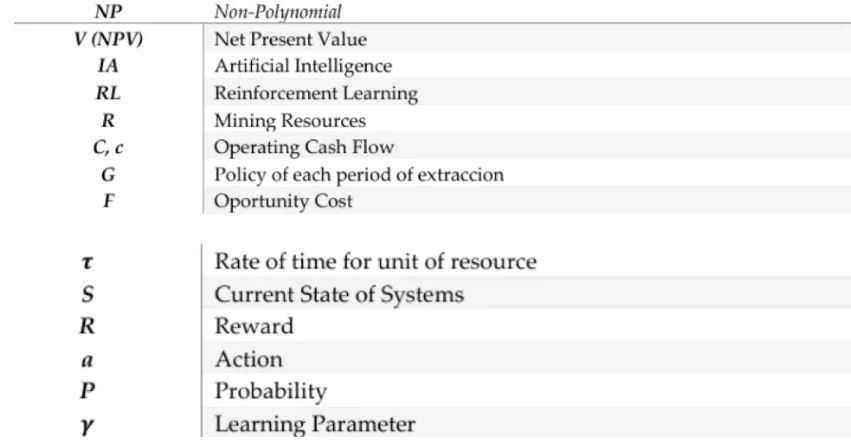
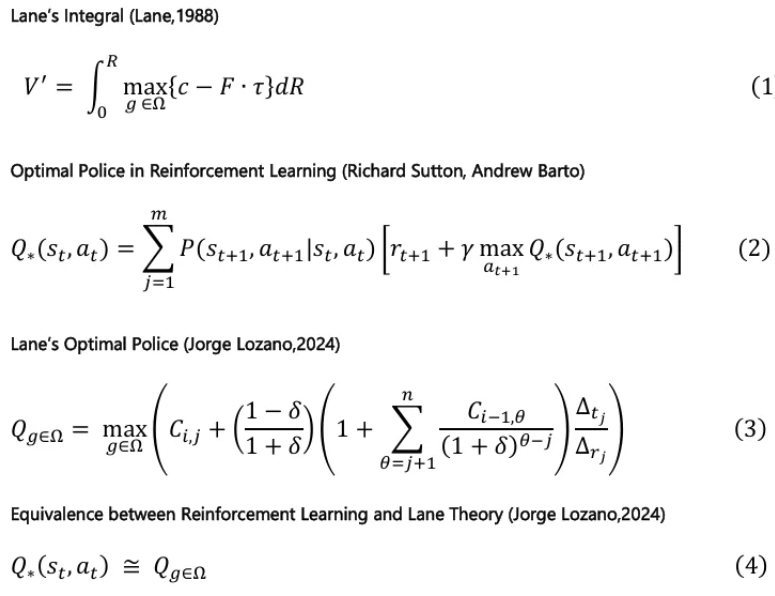
In 1988, Lane established the equation illustrated in Figure 1. By evaluating a definite integral over the range from 0 to R, the maximum economic value can be estimated. In practical terms, instead of attempting to solve a complex integral formulation all at once, we allow an agent to improve its decisions progressively through repeated attempts and feedback.
Lane's 1988 formulation of the economic value of ore addressed this problem through dynamic programming. Sutton and Barto subsequently provided the foundations for expressing sequential decision-making problems in reinforcement learning through the Bellman equation and Markov decision processes. In my 2024 master's thesis, I reformulated Lane's integral as a Q-learning problem and demonstrated the equivalence between the two formulations, as presented in Equations 1–4.
We also developed and tested a software prototype using a simplified mine model. In addition, a graph-based data structure was introduced to record the agent's learning trajectory and integrate planning capabilities.
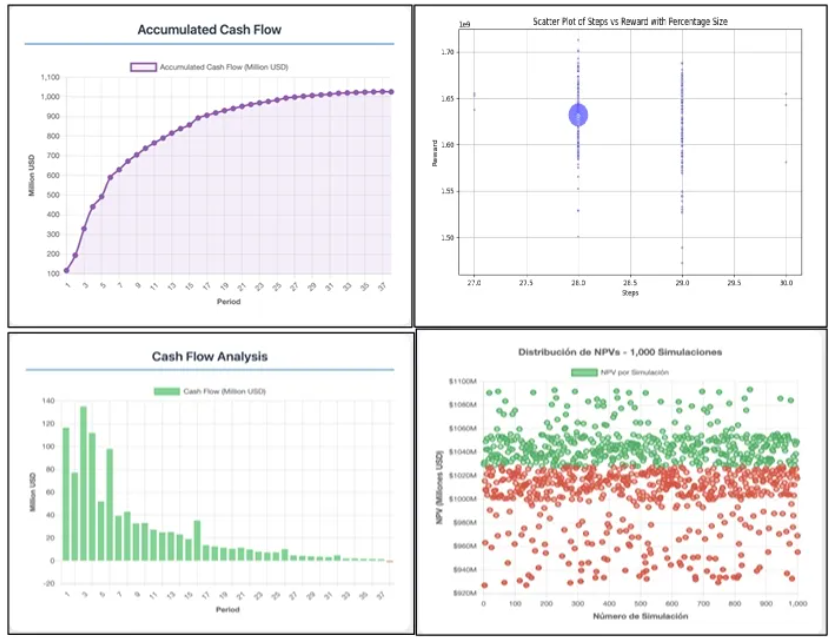
The experimental results show a continuing increase in net present value, indicating that the intelligent agent is progressively approaching a higher-value solution.
Based on ore grade and available processing capacity, the reinforcement learning agent adjusts its extraction and processing decisions. Importantly, it develops these strategies through interaction with the environment rather than relying on manually specified mining rules.
The optimal solution identified by the agent, together with other feasible solutions generated during learning, can provide useful reference points for engineering analysis.
The study also presents a cumulative cash flow scatter plot and an NPV distribution based on 1,000 simulations. The reported cash flow figures include approximately US$1.1 billion, US$1.06 billion, US$1.02 billion and US$1.0 billion. These results illustrate the range of economic outcomes observed in the simulations.
The experimental findings indicate that the agent can do more than identify a single optimal solution. It can also generate a range of feasible solutions, giving engineers additional options to consider during mine planning.
Three findings are particularly noteworthy:
A range of feasible solutions: The agent identifies an optimal solution while also generating alternative strategies that may be useful for engineering evaluation.
Adaptive extraction decisions: It adjusts its strategy in response to changes in ore grade and processing capacity.
Progress towards economic optimisation: The upward trend in NPV indicates that the agent is learning to improve the economic value of its decisions.
Consider a hypothetical example: if market prices suddenly decline, a conventional mine plan may need to be recalculated manually. An adaptive agent, by contrast, could reassess its decisions and favour higher-grade ore while postponing the extraction of lower-grade material, provided that the updated economic and operational constraints support this choice.
This illustrates the potential value of reinforcement learning in mine planning: the ability to evaluate alternative decisions as conditions change, rather than relying exclusively on a fixed plan.
By combining reinforcement learning with Lane's theory, we have developed a mine planning agent designed to adapt to changes in operating conditions and economic assumptions.
The research presents what its authors describe as the world's first AI agent to address strategic mine planning entirely through reinforcement learning, without relying on prior mining expertise encoded into the agent.
This is more than a research milestone. It offers a glimpse of how mine planning could evolve.
Greater intelligence and adaptability: AI agents can learn from their environments and adjust their decisions as conditions change, complementing traditional planning methods.
Support for greener, lower-carbon operations: The same optimisation principles could be extended to fleet scheduling and operational decisions, helping reduce unnecessary energy consumption.
Broader applications: From copper and iron ore mines to resource projects across South America and Asia, the approach offers a potential foundation for addressing a wider range of resource optimisation challenges.
The future mine will be more than a world of iron and fire. It will be an intelligent, connected and increasingly efficient digital operation—where data, algorithms and engineering expertise work together to support better decisions.