- sales@hot-mining.com +86 28 8331 1885 +86 15196677188
-

-

-


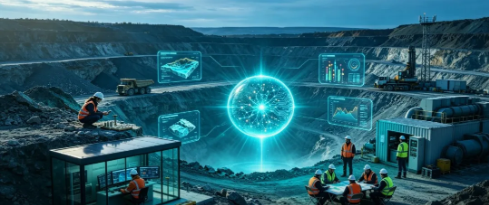
Artificial intelligence (AI) agents are evolving from conversational partners into systems capable of executing tasks. The traditionally conservative mining industry is now approaching the forefront of this transformation, opening the door to a new paradigm of human-AI collaboration that moves beyond experience-driven operations.
A recent Harvard Business School AI Institute insight article, How AI Agents Are Changing the Way We Work, highlights how AI agents are fundamentally reshaping knowledge work. Based on the working paper How AI Agents Reshape Knowledge Work: Autonomy, Efficiency, and Scope by Jeremy Yang and co-authors, the research draws on real-world data from Perplexity to examine the profound changes that occur when the execution of work shifts from humans to machines.
For the mining industry, which has long relied on geological expertise, capital-intensive exploration and complex safety management, these findings point to a fundamental shift in the productivity paradigm.
The research identifies two key dimensions that distinguish AI agents from traditional chatbots: autonomy and environmental integration.
Autonomy refers to an agent's ability to plan and take action with limited human intervention. Environmental integration refers to its ability to read from and write to a user's digital environment, including computers, browsers, external connections and third-party services.
Although large language model (LLM)-based chatbots such as ChatGPT have more limited capabilities in these areas, agent-based tools such as OpenAI Codex, Claude Cowork and Claude Code, and Perplexity Computer represent a significant step forward in autonomous planning and interaction with digital environments.
For example, when using an agent orchestration platform, a user may only need to define a goal, such as "complete a geological report." The system can then independently carry out a series of tasks, including research, coding, content development, coordination with external systems and final deliverable preparation.
This capability has considerable potential in mining applications.
In the future, a mining engineer may simply instruct an AI agent to "analyze the latest exploration data for a specific mining area and generate a preliminary drill-hole deployment plan."
The agent could then retrieve relevant geological databases, run modeling software, generate an initial proposal and coordinate with visualization tools to present the results.
Such workflows could significantly shorten the time between data collection and decision-making.
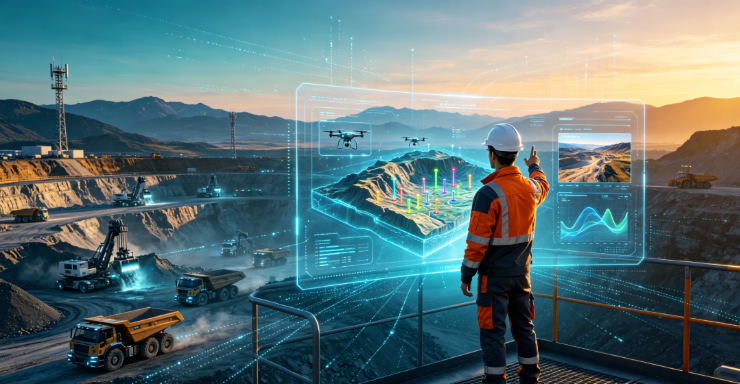
The research further develops an individual-level task-cost framework that breaks work into discrete steps and tracks the costs associated with completing them, including time, effort and financial expenditure.
Its central finding is that conversational AI and AI agents have fundamentally different cost structures.
Traditional conversational AI, such as conventional search tools, generally involves low upfront costs but high marginal costs. It is easy to get started: users simply ask a question and receive an answer. However, users must still determine the next step, ask follow-up questions, interpret the responses and manually process the results.
AI agents, by contrast, involve higher upfront costs but lower marginal costs. Users must define objectives carefully and establish appropriate validation standards. Once the task is initiated, however, the agent can independently plan and execute most or even all of the workflow.
This trade-off means that the real value of AI agents lies in spreading their initial setup costs across longer and more complex tasks.
For short tasks, a chatbot may remain the more efficient option. For complex, multi-step tasks involving coordination across multiple systems, AI agents can offer a substantial advantage.
More importantly, they expand the range of tasks that are economically feasible, enabling users to undertake high-value work that would previously have been too time-consuming or costly.
Mining projects are typical examples of long-cycle, highly complex workflows.
From mineral exploration and resource estimation to feasibility studies, mine design and construction, each stage involves dozens or even hundreds of individual tasks.
Under traditional workflows, geologists and engineers spend considerable time manually organizing data, performing preliminary calculations and preparing technical documentation.
With AI agents, the initial setup may require substantial effort to define project objectives, parameters and validation criteria. However, once the workflow is established, agents can independently perform intermediate tasks such as data cleaning, model calculations and report generation.
This allows mining professionals to spend less time on repetitive execution and more time on higher-level interpretation, technical judgment and decision-making.

The research uses a natural experiment to examine the real-world impact of AI agents.
Drawing on Perplexity usage data collected between February and May 2026, the researchers identified 10,000 pairs of comparable sessions in which the same users performed nearly identical tasks using either conversational AI (Perplexity Search) or an AI agent (Perplexity Computer).
To ensure that the agent sessions involved actual task execution rather than simple conversation, the researchers included only sessions in which users had invoked at least one execution tool, such as code execution, browser operations, file writing or external API calls.
The researchers then combined three approaches to assess the efficiency difference between the two workflows:
• Tool-by-tool estimates of task execution;
• Independent estimates generated by large language models, calibrated against wage data from the U.S. Bureau of Labor Statistics; and
• Interviews with 25 active users.
The study compared two working models: Perplexity Search + human execution and Perplexity Computer + human supervision.
The findings were striking.
Significant Productivity Gains
Under the Perplexity Computer + human supervision model, the estimated average task completion time fell from 269 minutes to just 36 minutes, compared with the Perplexity Search + human model.
This represents an estimated 87% reduction in task completion time.
The result is broadly consistent with an earlier independent LLM-based estimate, which indicated time savings of approximately 84%.
Improved Output Quality
More importantly, these productivity gains did not appear to come at the expense of quality.
The researchers analyzed users' subsequent messages across multiple rounds of interaction. Messages containing signals such as corrections, retries, repeated questions or error reports were treated as indicators of user dissatisfaction.
The results showed that the proportion of dissatisfied follow-up interactions was lower for Perplexity Computer than for Perplexity Search.
Expanded Roles and Broader Task Scope
Efficiency gains are only part of the story.
As execution tasks are delegated to AI agents, the role of human workers and the scope of their responsibilities begin to change fundamentally.
Instead of acting primarily as hands-on executors, people increasingly become supervisors and capability expanders. They spend more time reviewing and validating AI-generated outputs, while also using agents to explore tasks beyond their traditional areas of expertise.
This enables professionals to undertake more complex cognitive work and draw on a broader range of knowledge.
For example, a marketing professional may conduct more sophisticated financial analysis, a lawyer may prepare more comprehensive client materials, and a company founder may become more deeply involved in product development and design.
These findings have important implications for workforce transformation in mining.
In the future, the core value of mining engineers, geologists and mineral processing engineers may lie less in performing standardized calculations or preparing routine reports, and more in three areas:
1. Defining Objectives and Validating Results
Professionals will need to communicate task objectives, constraints and quality requirements clearly to AI agents.
Equally important will be their ability to critically review AI-generated outputs and assess whether the results are technically and geologically sound.
2. Cross-Functional Collaboration
AI agents can make it easier for engineers to work across adjacent disciplines.
For example, a mining engineer may use an agent to conduct preliminary cost and financial analysis, while a geologist may use one to explore basic mineral processing simulations.
This could support faster, more integrated decision-making at the mine-site level.
3. Focusing on Innovation and Complex Problem-Solving
By delegating repetitive work to AI agents, mining professionals can devote more of their cognitive resources to higher-value challenges, such as more accurate orebody modeling, mine plan optimization and environmental risk management.

The research emphasizes that AI agents do more than improve operational efficiency. They can also unlock human potential by expanding the boundaries of professional roles.
For executives and business leaders in the mining industry, adopting AI agents should therefore be viewed as more than a technology investment. It requires a fundamental rethink of how employees' capabilities can be developed and deployed.
This shift involves several priorities:
• Invest in objective-setting and output-validation skills. Training should focus not only on software operation, but also on defining clear objectives, setting appropriate constraints and critically evaluating AI-generated results.
• Redesign roles and responsibilities. AI agents should be treated as digital colleagues within the workforce. Employees should be encouraged to use them to expand their responsibilities and take on more complex tasks.
• Establish new human-AI collaborative workflows. Organizations need clear processes that define the respective roles of AI systems and human professionals, preserving human responsibility for supervision, judgment, creativity and value-driven decision-making.
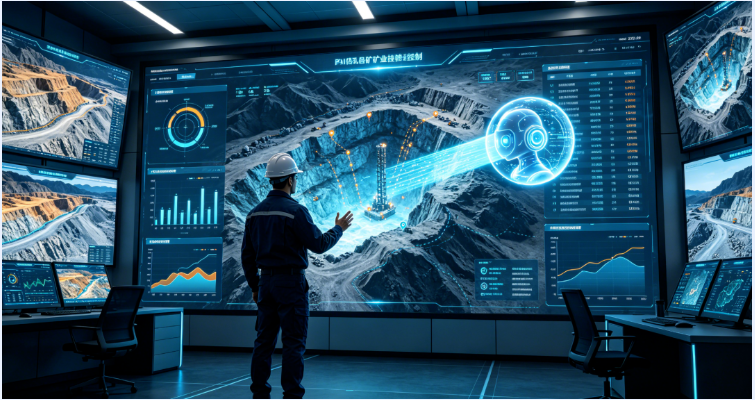
AI agents are transforming knowledge work from manual execution toward intelligent task delegation, objective setting and output validation.
As an industry that combines deep technical expertise with extensive reliance on practical experience, mining is approaching a critical turning point in this transformation.
The empirical research from Harvard Business School suggests that by handling complex, multi-step and long-cycle tasks, AI agents can deliver substantial productivity improvements while enabling a strategic upgrade in human roles.
The smart mine of the future will not simply be a highly automated facility. It will be an intelligent ecosystem in which mining professionals and AI agents work closely together.
Routine execution will increasingly be automated. Complex decisions will be supported by intelligent systems. Human experts will focus on innovation, professional judgment and value creation.
This is more than a technological upgrade. It represents a profound transformation in how the mining industry works, thinks and creates value.