- sales@hot-mining.com +86 28 8331 1885 +86 15196677188
-

-

-


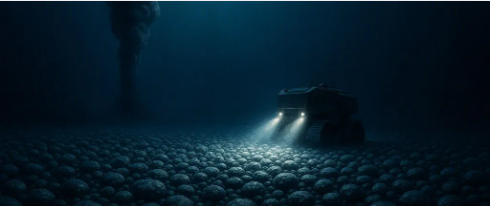
In the central Pacific Ocean, thousands of kilometers from the nearest coastline, lies a vast underwater plain shrouded in darkness, cold, and immense pressure.
Scattered across its seabed are hundreds of millions of black, potato-shaped rocks. Some have rested at depths of around 4,000 meters for millions of years. These seemingly unremarkable stones, known to scientists as polymetallic nodules, contain critical metals such as nickel, cobalt, manganese, and copper. Their estimated abundance is so substantial that it has been suggested to exceed the combined resources of many terrestrial mineral deposits.
Now, in 2026, as the global energy transition accelerates, these deep-sea "potatoes" have become the focus of growing competition among governments, mining companies, and environmental organizations.
On one side is the rapidly increasing demand for critical minerals driven by electric vehicle batteries, wind turbines, and other clean energy technologies. On the other is a growing body of scientific concern: once mining machinery begins operating on the seabed, ecosystems that humanity has barely begun to understand could suffer irreversible damage.
Deep-sea mining (DSM): Is it really the silver bullet that can solve our critical mineral supply challenges? Or are we risking a new ecological disaster in an attempt to address the climate crisis?

According to the International Energy Agency (IEA), between 2017 and 2022 alone, demand for cobalt from the clean energy sector increased by approximately 70%, while nickel demand rose by around 40%.
Even more concerning for many Western countries is the geographical concentration of mineral supply chains. A large proportion of global cobalt refining capacity is concentrated in China. Lithium production is heavily concentrated in South America's "Lithium Triangle," while China also maintains a dominant position in rare earth processing.
Against this backdrop, deep-sea mining has been presented as an attractive proposition: the ocean floor contains enormous mineral resources, far from geopolitical hotspots, with no need for land acquisition or relocation of communities, and without the risk of tailings dam failures associated with conventional land-based mining.
However, as recent research papers have pointed out, this narrative is an oversimplification.
Deep-sea mining involves highly complex economic, environmental, social, and governance trade-offs when compared with terrestrial mining.
The answer may disappoint those hoping for a permanent, one-size-fits-all solution to critical mineral supply challenges.
Deep-sea mining currently focuses primarily on three types of mineral resources.
1. Polymetallic Nodules
These are found mainly in the Clarion-Clipperton Zone (CCZ) of the Pacific Ocean.
They are rich in manganese (approximately 28–34%), nickel (1.1–1.3%), copper, and cobalt.
2. Cobalt-Rich Ferromanganese Crusts
These deposits form on the surfaces of seamounts, which are underwater volcanic mountains. Seamounts can also serve as important biodiversity hotspots.
3. Polymetallic Sulphides
These deposits form around deep-sea hydrothermal vents. The total area occupied by active hydrothermal vent fields worldwide is estimated at only around 50 square kilometers.
As of 2026, the International Seabed Authority (ISA) has issued 31 exploration contracts. China holds five of these contracts, placing it among the leading countries, followed by South Korea and Russia.

Upfront Investment: Regulatory Uncertainty Is a Major Cost
The ISA has been working on mining regulations since 2011, but progress has been extremely slow.
In April 2025, Norway's Loke Marine Minerals declared bankruptcy. One of the key challenges cited was its inability to secure financing amid uncertainty over the regulatory framework.
Mining Costs: The Risks Behind Optimistic Estimates
In 2025, The Metals Company (TMC) published a pre-feasibility study estimating total capital expenditure at approximately US$554 million.
However, there is a recurring problem with mining project cost estimates: they are often overly optimistic.
McKinsey research has found that 83% of large mining projects experience actual capital expenditure overruns of more than 40%.
Processing and Refining: The Enormous Costs Often Overlooked
Unlike conventional terrestrial ores, the chemical composition of polymetallic nodules means that most existing smelters are not equipped to process them.
Building refining facilities in the United States alone could require more than US$4.4 billion in capital expenditure, accounting for nearly 90% of the total project investment.
Market Disruption: Who Pays the Price if Commodity Prices Collapse?
If large volumes of cobalt from deep-sea mining enter the market, artisanal miners in the Democratic Republic of the Congo (DRC) could be among the first to feel the impact.
Simply driving down the economic value of cobalt would not necessarily improve local child labor conditions. In fact, it could make the situation worse.
A World We Barely Understand
The deep sea is the largest habitat on Earth and one of the least understood ecosystems.
The crevices and surfaces of polymetallic nodules provide habitats for microscopic organisms, including nematodes and tardigrades.
These nodules are effectively non-renewable resources on a human timescale. Their formation takes millions of years.
Once removed, the species that depend on them may not simply recover. Some could face extinction.
Impacts on Timescales Beyond Human Experience
Even under the most optimistic estimates, the recovery of animal communities could take decades.
The removal of the underlying mineral substrate, however, could have consequences lasting millions of years.
The Misleading Claim That Deep-Sea Mining Is “Greener”
Supporters of deep-sea mining argue that it may be more environmentally friendly than terrestrial mining.
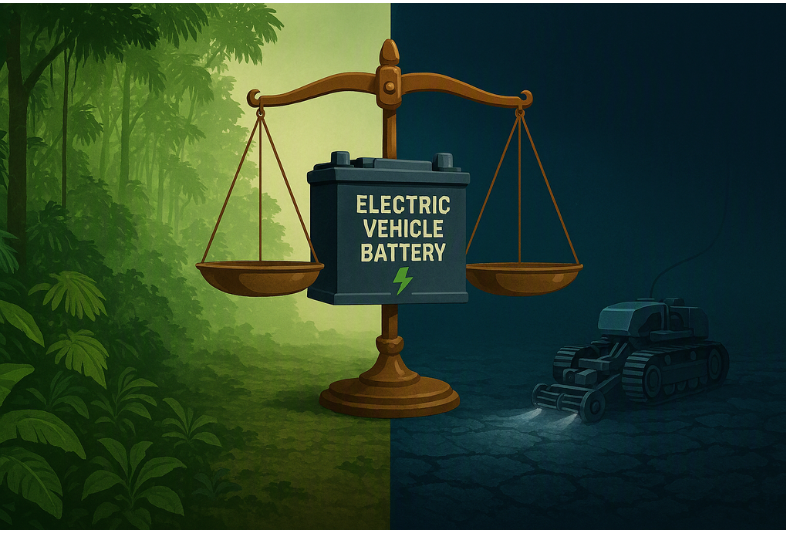
But this argument contains a critical logical flaw: it assumes that deep-sea mining will replace land-based mining.
If both continue to develop in parallel, deep-sea mining will not necessarily reduce the existing environmental burden. Instead, it could add an entirely new layer of ecological damage.
The United Nations Convention on the Law of the Sea (UNCLOS), adopted in 1982, defines the mineral resources of the international seabed Area as the common heritage of humankind.
However, while multilateral negotiations remain deadlocked, unilateral actions are accelerating.
The United States has used executive orders to create pathways for certain companies to pursue seabed mineral activities outside the ISA framework.
Pacific Island activists have argued that such approaches effectively use the language of justice to legitimize a new form of extractivism.
The Central Question: Substitution or Addition?
The most likely outcome is that deep-sea mining and terrestrial mining will coexist for an extended period.
We are therefore not simply replacing one form of environmental impact with another.
Instead, we may be adding a new source of potentially irreversible deep-sea ecological damage on top of the environmental and social burdens that already exist.
Faced with these complex trade-offs, the research paper puts forward several clear and pragmatic recommendations:
1. Uphold the Precautionary Principle
Deep-sea mining should not be rushed forward while major scientific uncertainties remain unresolved.
2. Establish Independent Environmental Baselines and Monitoring Systems
Without reliable baseline data, it is impossible to establish meaningful thresholds for environmental damage or assess the full impact of mining activities.
3. Develop Fair Benefit-Sharing Mechanisms
The interests of communities that depend on marine ecosystems for their livelihoods must not be overlooked.
4. Ensure Meaningful Public Participation
Public engagement should go beyond procedural exercises involving simple notification and comment periods. Stakeholders must have genuine opportunities to participate in decision-making.
5. Integrate Deep-Sea Mining into a Broader Critical Minerals Strategy
The priority should be demand-side management: reducing overall mineral demand, improving resource efficiency, and expanding battery recycling.
The black nodules that have rested on the Pacific seabed for millions of years will not disappear simply because we wait another decade.
But if we act too hastily, the unique forms of life that depend on them could disappear forever before we even have the chance to identify and name them.
The energy transition is urgent, but urgency must never become an excuse for recklessness.