- sales@hot-mining.com +86 28 8331 1885 +86 15196677188
-

-

-


Between two screens lies another giant copper mine.
This is not a metaphor. At least, not entirely.
In 1988, a regional geological survey team from the Xizang Bureau of Geology and Mineral Exploration was investigating geological anomalies in the Mozhugongka County area of Xizang. During the survey, they came across a green river known as the Peacock River.
Its water displayed an unusually vivid emerald-green color. Although there were no corresponding copper geochemical anomalies in the surrounding soil, porphyry copper and skarn-type mineralization had been identified upstream.
The geologists followed the river toward its source. They found signs of mineralization, but at the time, no one knew what lay beneath their feet.
The Julong porphyry copper deposit is located in the eastern Gangdese metallogenic belt. It formed approximately 15 million years ago in a tectonic setting associated with the transition from convergent orogenic processes to an extensional strike-slip regime.
From the initial discovery of exploration clues in 1988, to the designation of the Julong area for preliminary investigation in 2002, the estimated copper metal resources reached 7.05 million tonnes, already placing the deposit in the super-large category.
Exploration was completed in 2007, with a formal exploration report subsequently submitted.
Nearly twenty years had passed.
But the real question was never simply how much copper lay underground.
The real question was: How could that copper be converted into cash flow?
Julong is a low-grade copper deposit. Its average grade is below 0.5%, while some lower-grade resources have a copper grade of just 0.317%.
The mine is also located in an extremely challenging environment. Its ore bodies are distributed across a high-altitude plateau at elevations of approximately 4,000 to 5,400 meters. Average annual temperatures are below freezing, oxygen levels are less than half those at sea level, and the effective annual construction season is shorter than six months.
Developing the deposit was an enormous engineering challenge.
In 2005, S&P Global documented 20 giant copper discoveries worldwide with resources exceeding 10 million tonnes over the preceding 33 years. Only one of those discoveries was in China: Julong Copper, identified that year.
Yet despite its world-class resource potential, the deposit remained largely dormant for years because of its low grade and difficult development conditions.
In 2013, Chen Renyi, then Director of the Resource Evaluation Department at the China Geological Survey, described the discovery of Julong Copper as a turning point in the development of Xizang's mining economy.
Even so, before that turning point could become reality, Julong Copper had experienced a construction suspension due to funding constraints.
A world-class copper deposit was sitting underground, waiting for someone to develop it.
In June 2020, Zijin Mining announced that it would acquire a 50.1% stake in Julong Copper for RMB 3.883 billion in cash.
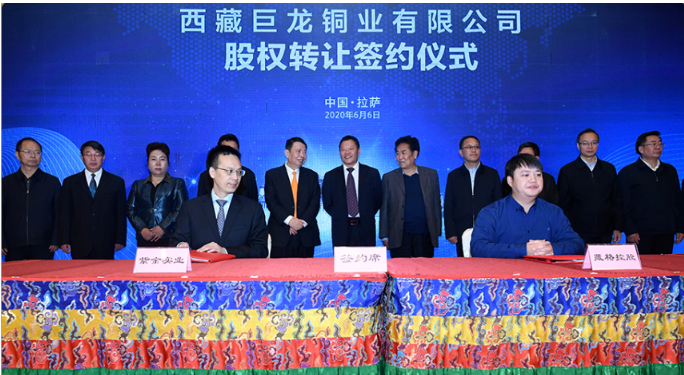
At the time, many considered the price expensive.
Julong Copper had approximately 10.41 million tonnes of copper resources recorded in its project filing. The deposit was low-grade, located at high altitude and extremely difficult to develop. Its previous owner had already suspended construction because of financial difficulties.
But Zijin Mining saw more than the copper underground.
It saw the potential for Julong to become China's largest copper mine once fully developed.
It also recognized China's heavy reliance on imported copper concentrates and the strategic importance of securing domestic copper supply.
Demand was growing from multiple directions. Renewable energy, power-grid expansion and data centers were all driving increased copper consumption.
More importantly, Zijin Mining saw a clear development pathway: turn the copper underground into cash flow as quickly as possible.
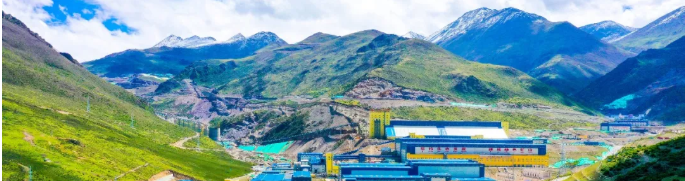
Image: Phase I of the Julong Copper Mine project.
In December 2021, Phase I of Julong Copper officially commenced production.
Only approximately 18 months had passed between the acquisition and the start of production.
The project was designed for an ore processing capacity of 150,000 tonnes per day. Copper production in 2022 was expected to reach 120,000–130,000 tonnes, with annual production of approximately 160,000 tonnes at full capacity.
But this was only the beginning.
On January 23, 2026, Phase II of Julong Copper officially entered production.
Building on the existing Phase I processing capacity of 150,000 tonnes per day, Phase II added another 200,000 tonnes per day, bringing the total designed capacity to 350,000 tonnes per day.
This was not simply an incremental capacity expansion.
Annual ore processing capacity increased from 45 million tonnes to 105 million tonnes.
Annual mined copper production was projected to rise from 190,000 tonnes in 2025 to approximately 300,000–350,000 tonnes.
Annual mined molybdenum production was expected to increase from 8,000 tonnes to approximately 13,000 tonnes, while silver production was projected to rise from 109 tonnes to approximately 230 tonnes.
Julong Copper has become China's largest copper mine and is described as the world's highest-altitude super-large copper mine with an exceptionally low processing feed grade.
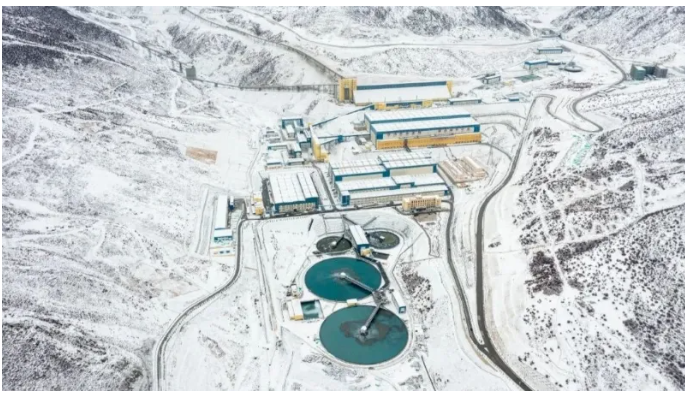
Image: Phase II of the Julong Copper Mine project.
Phase II involved a total investment of RMB 17.46 billion.
Located in a high-altitude environment above 5,000 meters, where low temperatures and oxygen deprivation create severe operating challenges, the project faced extraordinary construction and management demands.
Construction began in June 2024, and the project entered production just 18 months later.
Eighteen months.
On a plateau at an elevation of approximately 5,200 meters.
The project team adopted China's first gearless-drive ball mill system. The mill measures 8.53 meters in diameter and 14.63 meters in length and is equipped with a 24,000 kW ring-shaped synchronous motor. A single processing line can handle an average of up to 46,000 tonnes of ore per day.
Other technologies, including cantilever roadheaders for hard-rock excavation and specialized foundation treatment for complex high-altitude glacial deposits, were also applied under conditions described as first-of-their-kind in China.
Behind these figures were countless days and nights of work in an environment defined by extreme cold and oxygen deprivation.
By the end of 2024, the cumulative copper resources recorded with the relevant natural resources authorities had reached 25.88 million tonnes.
That is approximately 2.5 times the 10.41 million tonnes verified when Zijin Mining acquired its stake.
This makes Julong the copper mine with the largest registered copper resource base in China.
The deposit also contains associated resources of approximately 1.672 million tonnes of molybdenum and 15,145 tonnes of silver.
What does 25.88 million tonnes of copper represent?
Global copper mine production in 2025 was approximately 23 million tonnes.
In other words, the registered copper resources of Julong alone exceed one year's global copper mine production.
And this is not the end of the story.
Phase III is currently under planning.
Subject to approval by the relevant government authorities, the ultimate mining elevation is expected to be lowered from 4,452 meters under Phase II to 3,880 meters.
The copper resources available for development within the proposed final pit limits could exceed 20 million tonnes, while annual ore mining and processing capacity could reach approximately 200 million tonnes.
At full production, annual copper output could reach approximately 600,000 tonnes.
Six hundred thousand tonnes of copper every year.
That would place Julong among the world's largest single copper mining operations.
The financial contribution is already substantial.
In 2025, Julong Copper reportedly generated net profit of RMB 9.04 billion.
Zangge Mining, which holds a 30.78% stake in Julong Copper, recorded investment income of RMB 2.782 billion in 2025, accounting for 72.23% of its net profit attributable to shareholders of the parent company.
In the first half of 2026 alone, Julong Copper reportedly generated revenue of RMB 15.004 billion and net profit of RMB 9.223 billion.
A copper mine is becoming a powerful cash-generating asset.
Phase I, Phase II and Phase III all represent capacity expansion.
More mining capacity. More ore throughput. More copper production.
All of this matters.
But it is not the point I want to make.
Here is a more fundamental question:
Since Julong Copper began production in 2021, has there been a dividing line between its mine and its processing plant?
Phase I was designed to process 150,000 tonnes of ore per day. Phase II added another 200,000 tonnes per day, bringing total capacity to 350,000 tonnes per day.
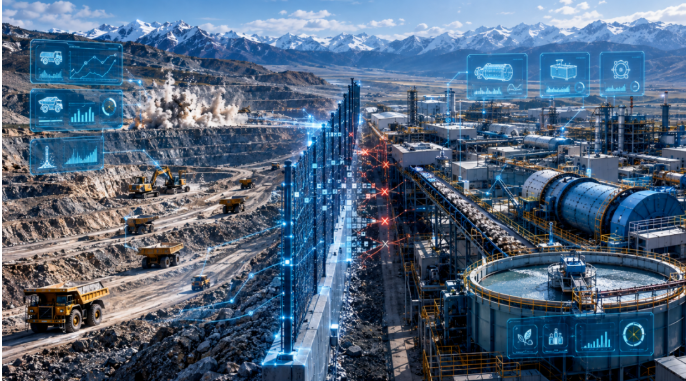
The processing flowsheet combines SABC grinding, high-pressure grinding rolls (HPGR), copper-molybdenum bulk flotation, copper-sulfur bulk flotation, copper-molybdenum separation and copper-sulfur separation.
It represents an integrated technological innovation in the processing of copper-polymetallic ores under high-altitude and cold-climate conditions.
The flowsheet is sophisticated.
But I want to ask a more fundamental question:
Are the particle-size distribution of mine blast fragmentation and the feed particle size of the processing plant's grinding mills being optimized as part of the same system?
Are haul truck cycle times, queues in front of crushers and stockpile inventories displayed on the same screen as mill power consumption, flotation recovery and reagent consumption?
At Julong, as at many other mines around the world, the answer is likely to be no.
The mine is managed separately from the processing plant. Blasting is managed separately from grinding.
There are two sets of KPIs, two groups of suppliers and two screens.
The ore moving between them is measured twice, while someone reconciles the numbers manually in Excel once a month.
That is the organizational gap.
Let's return to the number mentioned at the beginning.
Approximately 23 million tonnes of copper are mined globally every year.
What proportion of this production is constrained by processing capacity rather than ore grade or market demand?
No one publishes a definitive figure.
For illustration, assume conservatively that one-third of global copper mine production is affected by processing constraints.
If throughput across this portion of the industry could be improved by 15%, the additional annual copper output would be approximately 1.15 million tonnes.
Once Julong Phase II reaches full production, annual copper output is expected to reach 300,000–350,000 tonnes.
When Phase III reaches its projected capacity, annual production could reach 600,000 tonnes.
A 15% increase in effective processing throughput would therefore represent an additional 45,000–90,000 tonnes of copper per year.
At prevailing copper prices, this could translate into incremental annual revenue worth hundreds of millions to more than RMB 1 billion, without requiring a new orebody, new mining permits or an entirely new processing plant.
The ore is already moving through the mining and processing system.
This is the real hidden treasure.
It is not another portion of the 25.88 million tonnes of registered copper resources.
It is production capacity that already exists within the operating system but has been fragmented by organizational structures.
It is an invisible mine hidden in the gap between the mine and the processing plant.
In 1867, Peter von Rittinger published his theory of comminution, establishing a relationship between the energy required to break rock and the increase in newly created surface area.
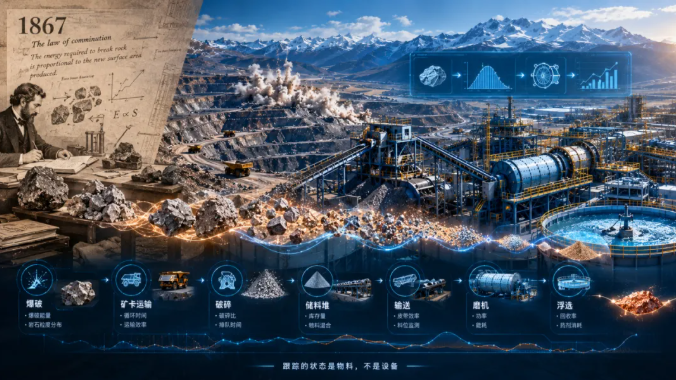
Applied to mining, the principle is straightforward:
If more fragmentation is achieved through blasting in the pit, less energy may be required for grinding in the processing plant.
The underlying physical mechanism has not changed in 159 years.
In 1994, Scott and McKee demonstrated this concept at a coal mine in Hunter Valley, Australia, by treating blasting and grinding as a single optimization problem. The proportion of fine material in the processing plant feed was reduced from 13% to 10%.
The work was followed by AMIRA P483, a research program conducted by the Julius Kruttschnitt Mineral Research Centre between 1996 and 2002.
At Papua New Guinea's Porgera mine, SAG mill throughput increased from 673 tonnes per hour to 774 tonnes per hour, an improvement of approximately 15%.
The reported approach involved increasing explosive consumption from 0.24 kg per tonne to 0.38 kg per tonne.
These are identifiable mine sites with published results and documented dates.
For decades, the underlying principle has remained well established.
Yet a 2024 review published in Minerals still described mine-to-mill integration as an emerging research area.
Why?
Because organizational structures often make integrated optimization difficult.
An asset can only be measured and optimized if someone is accountable for it.
Mining companies typically report operational performance according to their internal organizational structures.
And right in the middle of those structures lies a dividing line.
Consider Anglo American's 2025 annual report.
On page 27, the company reports a 14% improvement in overall equipment effectiveness for its autonomous fleet at Los Bronces.
On page 29, it reports an additional 600,000 tonnes at Minas-Rio, attributed to flotation improvements and process control.
These are five separate operational achievements, each measured against its own baseline and performance denominator.
Yet the report does not provide a single metric linking fleet performance to flotation performance.
Freeport-McMoRan's 2025 Form 10-K presents a similar picture.
Its opening section reports that the leach program reached an annualized copper production rate of approximately 240 million pounds.
Twelve pages later, Bagdad is described as the first major mine in the United States to operate a fully autonomous haulage fleet.
Mill capacity is reported separately in terms of designed daily tonnage.
BHP describes autonomous haulage in Western Australia as a labor-productivity lever, without providing a corresponding numerical performance figure in the cited discussion.
Its Julong-related reporting, meanwhile, includes a hard production figure for copper cathode generated through saline-water leaching over a ten-year period: 410,000 tonnes.
Vale provides more detailed operational metrics for its mobile assets.
Its autonomous fleet has reportedly improved operational efficiency by 15% and reduced fuel consumption by 7.5%.
But these figures are measured against mobile-equipment baselines.
None is expressed in terms of the amount of material ultimately processed through the grinding mills.
Across five major mining companies — BHP, Rio Tinto, Anglo American, Freeport-McMoRan and Newmont — the distinction is clear: companies report the results of digital initiatives, but the relationship between digital investment and integrated mine-to-mill performance is much less visible in their public reporting.
Equipment manufacturers show a similar pattern.
By the end of 2025:
• Caterpillar had 827 autonomous haul trucks;
• Komatsu had 862 autonomous trucks; and
• Epiroc had 3,900 autonomous machines.
Every one of these figures counts equipment that moves.
None directly measures crushers, grinding mills, flotation cells or conveyor drives.
Julong Copper operates within the same organizational framework.
Mining belongs to the mining department. Mineral processing belongs to the processing department.
Blasting performance and grinding performance are likely recorded in separate systems.
The issue is not that these companies lack automation.
It is that automation is frequently implemented and evaluated within individual operational domains, rather than across the entire material flow.
Procurement is part of the problem, but engineering is an even bigger part of it.
A haul truck generates an event stream.
Its data is discrete, sparse and associated with a moving reference frame. It is meaningful at the level of individual loading and hauling cycles.
A grinding circuit, by contrast, generates continuous process signals.
Its data is dense and autocorrelated, and its performance is understood in terms of residence time and mass balance.
The natural unit of a haul truck is a load.
The natural unit of a grinding mill is tonnes per hour.
Between the two lie stockpiles and crushers.
A stockpile acts like a memory device, but its transfer function is not fully known.
A crusher destroys much of the material identity associated with the ore entering it.
To attribute one hour of mill performance to a specific blasting event, the system must track material identity through loading, hauling, dumping, blending, crushing and conveying.
It must do so across processes with time constants that differ by several orders of magnitude.
The industry often treats this as a reconciliation exercise, assigning it to monthly accounting.
But if the problem is addressed properly, it becomes a real-time state-estimation challenge.
This is precisely the kind of problem that modern machine learning can help address, and one that conventional control engineering alone may struggle to solve comprehensively.
This is where Physical AI has real potential in mining:
A learning model that treats the mine and the processing plant as one integrated system.
The state being tracked is the material, not the equipment.
An action taken in the pit is evaluated against its consequences in the processing plant eight hours later.
Physical AI in mining does not necessarily require inventing new physical principles.
It requires access to data from both sides of the organizational boundary.
The first challenge is sensing and connectivity.
Software comes next.
According to MarketsandMarkets, the global process automation and instrumentation market was valued at approximately US$74.2 billion in 2024.
Verified Market Research estimated the mining fleet management system market at approximately US$3.945 billion in 2025.
The market research itself is divided along the same organizational boundary.
There is no widely recognized market category specifically measuring the intersection between mining fleet optimization and mineral processing integration.
The investment landscape tells a similar story.
Spending on fixed-plant instrumentation and automation is estimated to be approximately 19 times that of the corresponding mobile-side investment.
The intersection remains largely unpriced because it has no clearly established procurement category and no dedicated vendor segment with an established commercial mandate.
Yet the market already differentiates between different types of industrial technology businesses.
Schneider Electric acquired AVEVA at a valuation reported at approximately 8.2 times revenue and 13.2 times annual recurring revenue (ARR).
Emerson took AspenTech private at an enterprise value of nearly US$16.8 billion.
The broader valuation logic suggests that industrial AI platforms with control over critical operational loops can command platform-level multiples, while dashboard-oriented service providers may receive more limited service-business valuations.
Capital is also flowing into Physical AI.
According to Crunchbase, Physical AI attracted US$47.4 billion in funding in the first half of 2026 alone, exceeding the total raised between 2022 and 2024.
Mariana Minerals reportedly completed a US$310 million Series B financing round in August 2026, led by Khosla Ventures, with participation from a16z, Breakthrough Energy, BHP Ventures, Mitsubishi Corporation and In-Q-Tel.
The investment opportunity is therefore beginning to take shape.
But the question remains: who will build the technology that connects the two sides of the mine-to-mill system?
Every electron in the energy transition depends on copper.
So does every data center, every transformer and every major defense project.
Julong Copper has 25.88 million tonnes of registered copper resources, making it China's largest copper mine by this measure.
Once Phase III reaches its projected production capacity, annual copper output could reach 600,000 tonnes, potentially making it the world's largest mining and processing operation by throughput.
But all these figures describe how much copper lies underground.
The real question is:
How quickly, with how little additional capital and with what degree of certainty can that copper be converted into cash flow?
The team at Lowell did not succeed by walking across the terrain more exhaustively than three armies.
They made a different decision: the absence of a surface signal does not mean there is no mineralization underground.
The second Julong Copper Mine is already sitting inside the installed operating system of the existing mine.
It has no new orebody to discover and no new processing plant to build.
It is hidden between the mine and the processing plant, between two screens and inside the manual reconciliation process that takes place once a month.
The company that captures this opportunity will not be just another fleet management provider.
Nor will it be merely another process control company.
It must understand both sides of the operation.
Mining valuation has never been determined solely by the quantity of ore underground.
What matters is how much free cash flow the ore ultimately generates for shareholders after accounting for mining, processing, logistics, sales, financing and the time value of money.
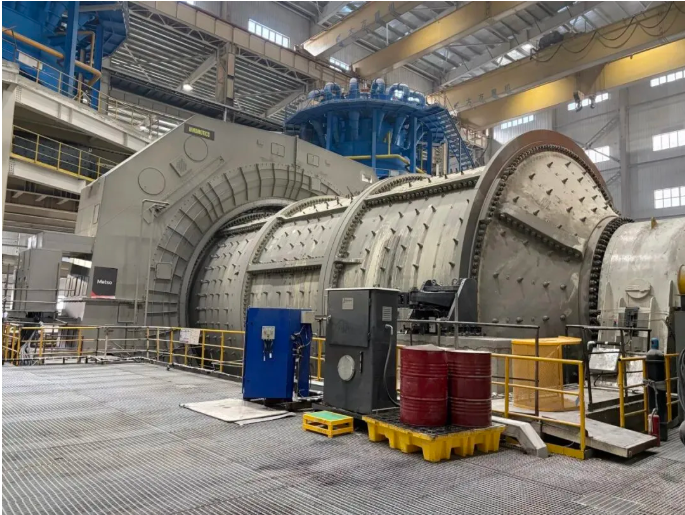
Mineral processing is the bottleneck.
Cash flow is the oxygen.
Julong Copper is demonstrating that China can build a world-class processing plant at an elevation of 5,000 meters in just 18 months.
The next step is to make that processing plant and the mine behind it operate as one integrated system.
Meanwhile, the hidden giant is still there.
Once a month, someone calculates it in a spreadsheet.
For years, that person has been right.