- sales@hot-mining.com +86 28 8331 1885 +86 15196677188
-

-

-



Whether you are an investor considering an ore deposit, a mining partner involved in a project, or simply someone with an interest in the mining industry, there is an often-overlooked issue worth paying attention to: geological debt.
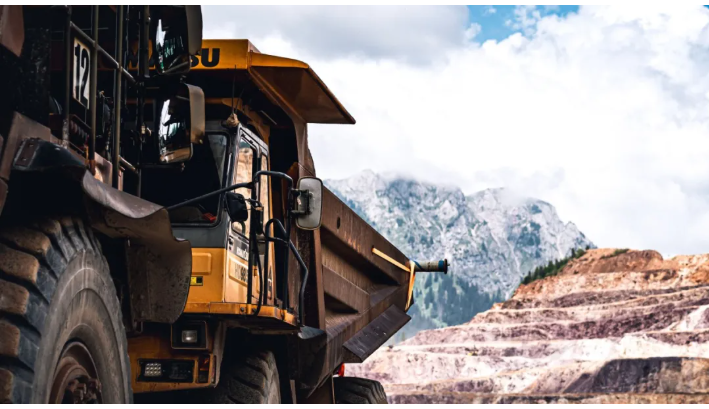
Major failures in mining projects are not always caused by obvious problems. More often, they stem from weaknesses embedded in geological work years earlier, which only begin to surface when a project reaches the development or production stage. Geological debt arises when a Feasibility Study (FS) team chooses to overlook actual geological conditions in order to simplify its work.
Every compromise may make the current model look cleaner and more orderly, but it does not eliminate the underlying risk. It merely postpones that risk, leaving subsequent project stages to bear the eventual cost.
In fact, many mining professionals have seen similar situations: an orebody that appears highly favourable in a study report proves extremely challenging to mine in practice; or grade control results at the mine site turn out to be dramatically different from the seemingly perfect block model developed six months earlier.
There is no shortage of such examples. What is often missing is a common term to describe the underlying problem: geological debt.
Of course, I am not suggesting that mining projects are affected by geological factors alone. Delays in environmental permitting, challenges in securing social and cultural acceptance and a social licence to operate, infrastructure bottlenecks, and even the exhaustion of available funding can all bring a project to a standstill or cause it to fail.
Although these risks can be significant, most can be identified and managed through early-stage planning, stakeholder engagement and adequate financial resources.
Geological debt is different. It relates directly to the geological characteristics of the ore itself and how those characteristics manifest in actual mining conditions. Mine plans, asset valuations and mineral processing flowsheets all ultimately depend on an accurate understanding of these conditions.
If geological assumptions are wrong at the Feasibility Study stage, no amount of sophisticated financial engineering can rescue the cash flow once the mine enters production and ore begins to be extracted and transported.
So, how can you tell whether a project is quietly accumulating geological debt?
During Feasibility Studies, there is often a tendency to treat an orebody as a large, relatively uniform entity — essentially, a homogeneous block.
Whether this approach results from excessive drill-hole spacing, overly simplistic interpolation methods, or a desire to present investors with a clearer and more orderly project outlook, the outcome is much the same: the model shows smooth orebody boundaries and regular geometries. It looks reassuring to investors and provides engineers with a convenient basis for design.
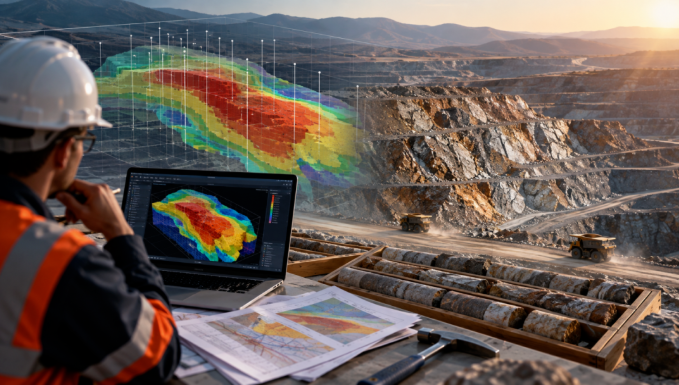
However, once a project enters production, those working at the mine site may quickly discover that this seemingly perfect model was, in reality, an expression of overconfidence.
I recently wrote about this issue in an article for Mining.com, examining how incomplete structural and geological domain models can expose projects to substantial financial risks that may be difficult to detect in the early stages.
PMET Resources' (PMET) approach to its Shaakichiuwaanaan lithium-caesium-tantalum (LCT) pegmatite project provides a useful example of why this issue deserves attention. Early-stage models can easily mistake the overall continuity of a geological body for uniformity in its mineral composition and properties.
In an LCT pegmatite, for example, assuming that the entire geological body has the same characteristics and behaves uniformly across all its zones can obscure the actual geological picture.
If a Feasibility Study smooths over internal waste-rock bands and distinct grade boundaries during modelling, grade control may face serious ore-versus-waste misclassification challenges from the very first day of production.
The risk is not limited to potentially overstating ore volumes. Once mining begins, site personnel may also struggle to identify the true spatial distribution of the orebody accurately.
That is geological debt.
Of course, the debt may be relatively small, or it may eventually develop into a risk severe enough to undermine the entire project. Either way, how much risk are you really willing to leave to chance?
A regular, apparently uniform block model can create a dangerous illusion: that mining is simply a matter of moving large quantities of rock from one place to another.
If a study overlooks structural features such as fault displacement, changes in vein orientation or the sudden pinching-out of veins, it may leave substantial operational risks for the production team to deal with later.
Consider the deposits of Galantas Gold in Northern Ireland. Its high-grade quartz-carbonate veins are controlled by complex shear zones and structural faults. These veins can change direction, narrow in thickness or even pinch out entirely.
If the mine plan relies only on broad rock-mass classifications without incorporating these structural features into the geological model, seemingly insignificant faults that have not been modelled can completely disrupt the planned mining sequence.
Another example is the Raleigh underground gold mine in Western Australia.
The engineering model for the project assumed that the orebody had a clear and predictable structure. In practice, however, the main target — the Raleigh Main Vein — exhibited highly irregular, narrow-vein characteristics, with an average ore thickness of less than 0.3 metres.
Although the project initially managed to push ahead with mining despite significant cost pressures and other difficulties, working within such an irregular mineralised zone ultimately came at a price: the mine was forced to suspend operations, and ownership subsequently changed hands.
If a Feasibility Study bases its economic forecasts on precise selective mining without adequately characterising the true complexity of the geological structures, geological debt has begun to accrue interest.
I know that "understanding" is not a formal technical metric. Neither the JORC Code nor NI 43-101 resource reports contain a dedicated section for measuring it.
Nevertheless, I believe it is worth emphasising: a genuine understanding of geological conditions is one of the important indicators of a project's ability to remain resilient over the long term.
It means having the discipline to make decisions based on fundamental geological principles, regardless of how unfavourable or uncomfortable the geological evidence may appear.
Unfortunately, sound geological understanding is often undervalued. When it is applied effectively, everything tends to look like routine day-to-day work. It is only after decisions prove wrong or operations fail to meet expectations that these issues receive significant attention during post-project reviews.
Rocks are almost always giving us early warning signals. We simply do not always recognise them.
In the previously mentioned PMET project, elements such as arsenic and antimony, which are associated with volatile geochemical signatures, may initially be treated primarily as parameters to be monitored for environmental compliance.
In reality, however, their spatial distribution can provide a distinct geological fingerprint, revealing the activity of the hydrothermal fluids that originally interacted chemically with the orebody.
Ironically, arsenic and antimony seem to follow a recurring pattern in geological processes: they have a habit of becoming difficult problems.
Similar observations have been made in studies of Carlin-type gold deposits in Nevada. Initially, elevated concentrations of arsenic and antimony presented a major processing bottleneck, requiring costly treatment before gold could be recovered. In addition, the spatial extent of identifiable gold mineralisation was too narrow to provide sufficiently effective guidance for exploration drilling.
Researchers subsequently made an important discovery. They realised that arsenic and antimony could be dispersed over a much wider area than the gold itself, forming broader alteration halos. As a result, these elements could provide more effective guidance for mineral exploration than simply tracing gold mineralisation alone.
What had initially appeared to be a troublesome factor ultimately became an important exploration indicator.
These signals are almost always hidden in the original drill-core data. The key is whether we can genuinely understand what they are telling us and turn that information into meaningful geological insight.
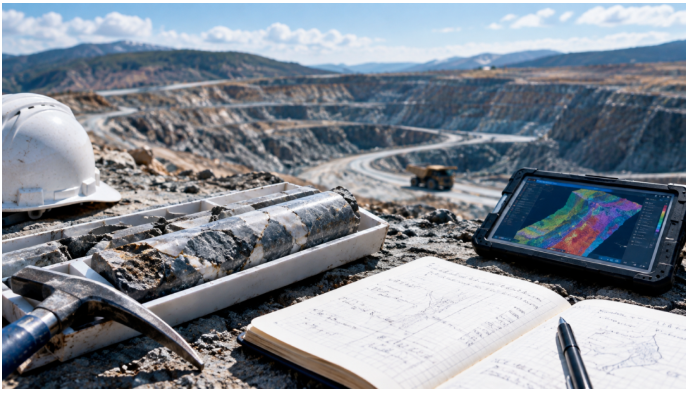
An adequate Feasibility Study can estimate ore tonnage. An excellent Feasibility Study can anticipate how the orebody will behave under actual mining conditions.
In a sense, it ultimately becomes a practical guide for site operations, providing future mining teams with the analytical framework, operating constraints and geological context they need to mine the orebody selectively and profitably — but, more importantly, predictably.
The difference between an "adequate" and an "excellent" Feasibility Study often comes down to how geological debt is handled.
The former leaves geological realities to be confronted after production begins. The latter identifies and addresses those risks while uncertainty can still be managed without incurring excessive costs.
So, how much geological debt is your project carrying?