- sales@hot-mining.com +86 28 8331 1885 +86 15196677188
-

-

-


One of the most notable developments in bioleaching in 2025 came from a real-world industry collaboration involving BHP. Endolith, a biotechnology company specialising in microbial mineral recovery, reported promising column-test results showing that engineered microorganisms could improve copper recovery from low-grade primary sulphide ores containing chalcopyrite and pyrite.
The findings point to a potential new way of unlocking value from mineralised materials that have traditionally been difficult or uneconomic to process.
On 13 May 2025, US-based biomining technology company Endolith announced that its engineered microbial platform had completed a series of column-leaching validation tests using actual low-grade primary copper sulphide ore samples supplied through BHP’s innovation programme, Think & Act Differently (TAD).
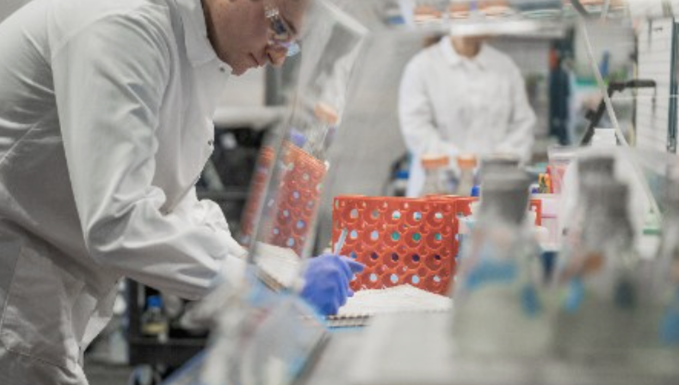
According to Endolith, the tests demonstrated faster leaching kinetics and higher copper recovery than conventional acid-based heap-leaching approaches.
Characteristics of the test ore:
• The ore primarily contained chalcopyrite and pyrite, with a total copper grade of less than 1%.
• It represented a type of primary sulphide ore widely recognised as particularly challenging to bio-oxidise and process.
• Test conditions included site-matched process solutions and column-leaching trials conducted across a temperature range of 30°C to 65°C.
Reported results:
Across all tested temperature ranges, Endolith's microbial cultures achieved faster oxidation rates and higher final copper recoveries than the conventional comparison process.
The results also indicated the potential to reconsider the economic value of mineralised waste materials that conventional processing approaches may have regarded as uneconomic.
Turning a Static Ore Heap into a Living, Adaptive System
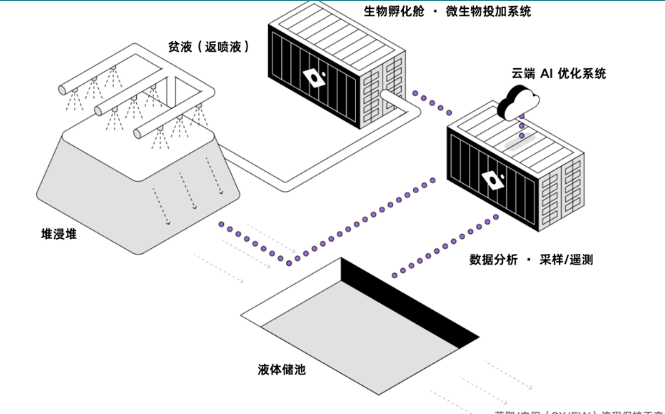
Endolith's approach combines customised microbial cultures with continuous monitoring and process optimisation. Its technical framework can be summarised in five stages:
01 | Genomic Analysis
Baseline sampling and genomic screening are used to identify suitable microorganisms for the mineralogical and geochemical conditions of a specific ore deposit. The aim is to select highly specialised acidophilic and thermophilic microorganisms capable of thriving under demanding leaching conditions.
02 | Customised Microbial Cultures
A site-specific bioleaching solution is developed based on the mineralogical characteristics of each mine. Rather than applying the same microbial formulation everywhere, Endolith aims to tailor microbial communities to the chemistry and operating conditions of individual ore bodies.
03 | Continuous Microbial Inoculation
Customised microbial cultures are continuously introduced into the ore heap through the circulating leach solution. This is intended to maintain active microbial populations and turn the heap into a dynamic biological reactor.
04 | Real-Time Process Optimisation
Sensors and cloud-based monitoring are used to track key operating parameters, including microbial activity, oxidation-reduction potential (Eh), pH and dissolved oxygen.
AI supports the feedback and optimisation process by helping operators adjust conditions in response to monitoring data, with the objective of maintaining favourable conditions for microbial activity.
05 | Improved Metal Recovery
The ultimate goal is to improve the recovery of copper and other critical minerals, potentially making previously uneconomic mineralised materials suitable for further evaluation and processing.
Enhancing the Process with an Integrated Biological Recovery Module
Endolith's broader technical framework further integrates several components:
• Bio-hatchery: Produces customised microbial cultures suited to the target ore and operating environment.
• Analytical unit: Monitors microbial performance and supports ongoing adaptation to changing process conditions.
• AI-assisted feedback loop: Uses operational data to support process adjustments and optimisation.
• Existing heap-leach infrastructure: Allows the biological recovery system to be integrated into established heap-leaching operations.
The central mechanism remains biological oxidation. AI serves as a process-monitoring and control tool rather than the primary extraction technology. This distinction is central to Endolith's positioning: combining microbial science with data-driven process optimisation.
Industry Background and Significance
Several long-term trends explain why technologies capable of improving copper recovery from low-grade ores are attracting increasing attention.
• A significant proportion of global copper resources occurs in low-grade or complex-to-process deposits, creating demand for more efficient extraction technologies.
• According to the International Energy Agency (IEA), the average grade of copper mines has declined by approximately 40% since 1991.
• BloombergNEF has highlighted the substantial investment required to expand the supply of metals needed for the energy transition. Its 2024 Transition Metals Outlook estimated that approximately US$2.1 trillion in investment would be required across energy-transition metals by 2050 under its Net Zero Scenario.
• Primary copper sulphide ores containing chalcopyrite can be particularly difficult to leach efficiently using conventional methods. Improving their processing performance could therefore expand the range of materials that can be considered for recovery.
For the copper industry, the challenge is not simply finding new deposits. It is also finding more effective ways to recover metals from existing resources, including lower-grade ores and previously underutilised mineralised materials.
What the Industry Participants Said
Dr. Liz Dennett, CEO of Endolith, commented:
"This demonstrates what is possible when the world's oldest miners—microbes—are put to work on one of today's biggest challenges. With support from the TAD programme, we have validated a scalable, low-impact solution that can unlock vast copper resources and help secure critical mineral supply chains for decades to come."
Holly Bridgwater, Co-founder of Unearthed, commented:
"At Unearthed, we exist to connect bold ideas with major industry challenges. Endolith's performance demonstrates what start-ups can achieve when they are given the opportunity to test and scale new technologies in real-world settings. This kind of collaboration is essential to unlocking the next generation of mining innovation."
Current Development Status
The BHP TAD collaboration represents an important validation milestone for Endolith's technology under simulated operating conditions.
The next critical step is to establish performance under larger-scale field conditions and assess how the system performs across different ore types, heap configurations and operating environments.
In the longer term, the underlying platform may also have applications in the recovery of other critical minerals, including lithium, nickel and rare earth elements. However, each application will require mineral-specific testing and validation.
If the technology can be successfully scaled and demonstrate commercial viability, its implications could be significant:
• Reassessing the value of historical waste materials: Mineralised waste dumps and low-grade stockpiles could be re-evaluated as potential sources of recoverable copper.
• Extending the productive life of existing mines: Improved recovery from existing resources could help support mine-life extensions, potentially reducing the need to rely exclusively on new mining projects.
• Moving biological processing towards industrial application: Microbial technologies could offer an additional processing option for challenging ores, with the potential to improve resource efficiency and reduce certain environmental impacts.
• Expanding into other critical minerals: Further research could explore applications in lithium, nickel and rare earth element recovery.
As conventional leaching approaches encounter technical and environmental challenges when applied to certain primary sulphide ores, engineered microorganisms and adaptive biological processing systems are emerging as promising areas of innovation.
The combination of microbial oxidation, continuous process monitoring and data-driven optimisation could provide the global copper industry with another way to improve recovery from existing resources.
The key question now is whether the promising column-test results can be translated into reliable, cost-effective performance at commercial heap scale.